What you get

Business Optimization Diagnostic

Stop Guessing What Your Business Needs. Find Out What Actually Deserves Your Attention.

You do not need to know exactly what is wrong with your business before you come to us.

That is what the diagnostic is for.

You tell us what is happening in your business, what concerns you, what you have already tried, and where you want the business to go.

Business Optimization Diagnostic — $297 Get Your Diagnostic  →

Then Business & Brand Intelligence takes a deeper look across the business to help determine:

  • What is working.
  • What may be getting in the way.
  • What may actually be causing the problem.
  • What opportunities you may be overlooking.
  • What deserves your attention first.
  • What can wait.

Why a Diagnostic?

When something is not working in your business, the problem you can see may not be the problem that actually needs to be solved.

It is easy to assume you need more marketing, a new website, different pricing, new software, more employees, AI, funding, or another solution.

But before you spend more money trying to fix the problem:

Find out what is actually causing it.

That is the purpose of the Business Optimization Diagnostic.

Big Businesses Have Teams Looking at the Business From Different Angles.

Larger companies can have entire departments responsible for understanding different parts of the business.

Marketing teamsstudy customers and demand.
Sales teamslook at leads, purchases, and lost opportunities.
Finance teamsmonitor costs, revenue, cash flow, and profitability.
Operations teamsexamine how work gets done.
Customer-experience teamslook at what customers experience before, during, and after a purchase.
Data and analytics teamslook for patterns, problems, and opportunities.
Technology teamsexamine systems, tools, automation, and efficiency.

Small-business owners are often expected to figure all of this out themselves.

Business & Brand Intelligence brings those different business perspectives together in one diagnostic.

We do not replace all of those corporate departments.

We use the same basic advantage they have:

Looking at the business as a whole instead of assuming one visible problem tells the whole story.

What Do We Look At?

We examine the major areas that can affect how your business performs, including:

Customers & Sales

How people become customers, where sales may be getting lost, and what may be affecting the buying process.

Marketing & Visibility

How people find the business, how the business is being presented, and whether visibility is actually contributing to the problem.

Operations

How work gets done day to day and where processes may be creating delays, waste, confusion, or capacity problems.

Money & Financial Visibility

What the available information tells us about revenue, expenses, pricing, cash flow, profitability, and how clearly the owner can see what is happening financially.

Customer Experience

What customers experience from first contact through the completion of the purchase or service.

Systems & Processes

How information, responsibilities, customer activity, and recurring work are tracked and managed.

Technology & AI

Whether current tools are supporting the business and where technology or automation may — or may not — make sense.

Owner & Team Capacity

What depends entirely on the owner, where capacity may be limited, and what may become difficult as the business grows.

Growth & Opportunities

Opportunities the business may already have but is not fully using, along with decisions that may need a stronger foundation before the owner invests in them.

We do not examine these areas as separate boxes.

We look at how they may be affecting one another.

What Happens After Your Interview?

Your information does not go straight into a report.

Once your intake and interview are complete, the deeper diagnostic work begins.

Your business goes through multiple stages of analysis and review before recommendations are made.

  1. 1

    We Organize the Evidence

    We bring together the information gathered from your intake, interview, supporting documents, and other relevant business information.

    Then we separate:

    • What we know.
    • What the owner reported.
    • What the available information supports.
    • What appears inconsistent.
    • What is still unknown.
    • What requires additional information before a conclusion can be made.

    A concern does not automatically become a finding simply because it was mentioned.

  2. 2

    We Build a Picture of How Your Business Actually Works

    We look at how:

    • Customers find you.
    • Customers contact you.
    • Customers become buyers.
    • Products or services are delivered.
    • Money enters the business.
    • Money leaves the business.
    • Information is tracked.
    • Work gets completed.
    • Problems are handled.
    • Responsibilities are divided.
    • The business functions when the owner is busy or unavailable.

    This allows us to see how customers, money, work, information, and decisions move through the business.

  3. 3

    We Examine the Business From Multiple Perspectives

    Instead of looking only at the problem the owner first noticed, we look across the business.

    We may examine the same situation from a:

    • Customer perspective.
    • Financial perspective.
    • Operations perspective.
    • Sales perspective.
    • Marketing perspective.
    • Technology perspective.
    • Capacity perspective.
    • Growth perspective.

    The purpose is to see whether different parts of the business are telling us the same thing — or whether the visible problem may actually be coming from somewhere else.

  4. 4

    We Identify Possible Problems and Opportunities

    Several issues may appear during the analysis.

    But they do not automatically become findings.

    We examine whether there is enough evidence to support them.

    We ask:

    • Is this actually happening?
    • How do we know?
    • Is there evidence somewhere else in the business that supports it?
    • Could there be another explanation?
    • Is this a current problem?
    • A future risk?
    • An opportunity?
    • Something to monitor?
    • Or something we do not yet have enough information to conclude?

    We do not want to turn assumptions into recommendations.

  5. 5

    We Look for the Root of the Problem

    This is one of the most important parts of the diagnostic.

    Imagine a business owner says:

    “I need more customers.”

    It would be easy to recommend more advertising.

    But first we need to know:

    • Are people already finding the business?
    • Are they contacting the business?
    • Are inquiries becoming purchases?
    • Where are potential customers dropping off?
    • Are existing customers returning?
    • Is the business able to handle more customers effectively?

    The owner may indeed need more customers.

    Or the business may already be attracting enough interest and losing opportunities somewhere else.

    What looks like the problem may only be the symptom.

    The diagnostic is designed to look deeper before recommending the solution.

  6. 6

    We Measure How Important Each Issue Is

    Not every problem deserves the same amount of attention.

    A business can have many things that could be improved.

    That does not mean all of them should be addressed at once.

    We assess issues based on factors such as:

    Financial ImpactHow much could this be affecting revenue, expenses, or profitability?
    Time & CapacityIs this consuming time or limiting what the business can handle?
    Customer ImpactAre customers or potential customers being affected?
    Risk & UrgencyDoes this require immediate attention or can it wait?
    FrequencyIs this an occasional problem or something built into how the business currently operates?
    Growth ImpactCould this keep the business from reaching the owner’s larger goals?
    Ability to Improve ItIs there a realistic action the business can take?

    This helps us distinguish between:

    Something that could be improved
    and
    Something that may actually be holding the business back
  7. 7

    We Look at How the Problems Connect

    Business problems rarely exist by themselves.

    One problem may be creating another.

    One issue may need to be addressed before another recommendation can work.

    A decision may need to wait until better information exists.

    So we look at:

    • What is connected?
    • What may be causing something else?
    • What depends on what?
    • What needs to happen first?
    • What decision should wait?
    • Where could the owner waste money by acting too soon?
  8. 8

    We Separate Importance From Order

    Something can be very important without being the first thing the owner should do.

    A business may eventually need:

    • A new website.
    • More marketing.
    • Employees.
    • Funding.
    • Different pricing.
    • Technology.
    • Expansion.

    But another issue may need to be handled first.

    That is why we determine both:

    What matters most
    and
    What needs to happen first.

    Those are not always the same thing.

  9. 9

    The Findings Are Reviewed Again

    The first analysis does not automatically become your final report.

    The conclusions are examined again from a practical business perspective.

    We ask:

    • Does this finding actually fit the information?
    • Are there other reasonable explanations?
    • Are two findings actually connected?
    • Are we saying more than the evidence supports?
    • Is this recommendation realistic for this business?
    • Could following this recommendation too early cause the owner to waste money?
    • Does the proposed order make sense?

    The purpose is to challenge the findings before we ask you to act on them.

  10. 10

    Your Diagnostic Goes Through a Final Review Layer

    Before your diagnostic is delivered, the findings, recommendations, priorities, and action sequence go through one final review.

    This final layer looks at the diagnostic as a whole and asks:

    • Do the findings fit the evidence?
    • Do the recommendations make sense together?
    • Are any conclusions stronger than the information supports?
    • Are there contradictions that still need to be reconciled?
    • Does the recommended order make sense for this business?
    • Is anything being recommended too early?
    • Could the owner waste time or money by acting before another issue is addressed first?
    • Do the findings, priorities, and 30 / 60 / 90-day plan all align with one another?

    The purpose of this final review is to make sure you do not receive a collection of separate observations.

    You receive one connected diagnostic, where the findings, evidence, recommendations, and priorities work together.

    No recommendation is delivered until the diagnostic has passed through this final review layer.

What Does All of This Mean for You?

All of that analysis has one purpose: to help you make better business decisions before you spend more time or money.

The diagnostic helps you:

Stop Guessing

You have a clearer understanding of where your attention may actually be needed.

Avoid Spending Money on the Wrong Solution

Before investing in advertising, websites, employees, software, technology, inventory, consultants, or expansion, you have more information about whether that investment addresses the real problem.

See What You May Not Be Able to See From Inside the Business

When you are running the business every day, the most visible problem can easily become the thing you focus on.

A whole-business review can reveal connections that are difficult to see from inside.

Understand Why Something May Be Happening

We do not simply tell you that something is wrong.

We show you what we found, what supports the finding, and why it matters.

Know What Deserves Your Attention First

Your time, money, and resources are not unlimited.

We help you separate: What needs attention now. What comes next. What can wait.

Know What NOT to Do Yet

Sometimes one of the most valuable recommendations is:

Do not spend that money yet. Do not hire yet. Do not expand yet. Do not change that yet.

Not because the idea is necessarily bad — but because something else should happen first.

Turn a Large Problem Into Manageable Steps

You leave with a 30 / 60 / 90-day sequence instead of a pile of disconnected recommendations.

What You Receive

Your diagnostic is delivered through three separate client documents.

1

Executive Summary

Your high-level view of the business.

It includes:

  • Your overall business situation.
  • Important conclusions.
  • Current strengths.
  • Areas needing attention.
  • Your diagnostic baseline.
  • What improvement should look like over the next 90 days.
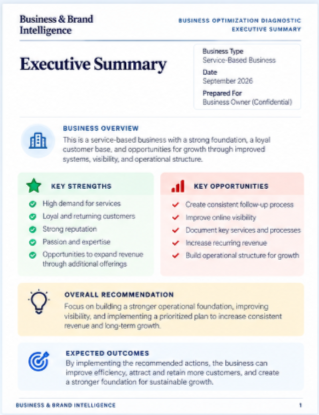
Preview of the Executive Summary document
2

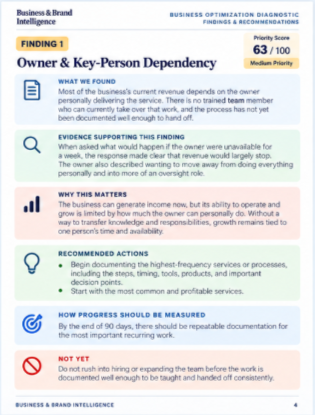
Diagnostic Findings & Supporting Evidence

This is the deeper analysis.

For each major finding, you see:

  • What We FoundThe issue or opportunity identified.
  • Evidence Supporting the FindingWhat information from your business supports the conclusion.
  • Why This MattersHow the issue may be affecting the business.
  • What You Should Do NowThe recommended action.
  • How Progress Should Be MeasuredHow you can tell whether things are improving.
  • Not YetThings that may make sense later but should not be prioritized yet.

Your diagnostic identifies 3–5 key findings based on your business.

Preview of the Diagnostic Findings and Supporting Evidence document
3

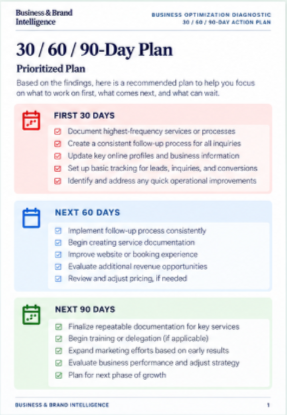
30 / 60 / 90-Day Action Plan

Your recommendations are put into order.

  • Days 1–30Stabilize the most important areas and begin collecting or correcting what is needed.
  • Days 31–60Build on the foundation and use the information from the first month to make better decisions.
  • Days 61–90Measure progress, revisit larger decisions, and determine what should happen next.

The goal is for you to know:

What to do now. What to do next. What can wait.

Preview of the 30/60/90-Day Action Plan document

See a Sample of What You Receive

These are shortened, anonymized previews.

They are shown only to demonstrate the type of analysis and information included.

Your complete diagnostic contains substantially more detail and is based specifically on your business.

How the Diagnostic Works

  1. 1

    Complete the Intake

    Tell us about your business, current situation, and goals.

  2. 2

    60-Minute Interview

    We ask the questions needed to understand how your business actually works and gather additional evidence.

  3. 3

    In-Depth Analysis

    Your information goes through the multi-level diagnostic and review process described above.

  4. 4

    Receive Your Reports

    You receive your Executive Summary, Diagnostic Findings & Supporting Evidence, and 30 / 60 / 90-Day Action Plan.

  5. 5

    30-Minute Review

    We walk through your findings, explain the reasoning behind the recommendations, and answer your questions.

What the Diagnostic Does NOT Do

The Business Optimization Diagnostic identifies problems, opportunities, priorities, and recommended next steps.

It is not a done-for-you implementation service.

B&BI does not automatically become your marketing agency, accountant, attorney, bookkeeper, employee, website developer, or operations manager.

When a finding requires specialized professional assistance, your diagnostic can identify what type of help may be needed and why.

The purpose is to help you understand where your resources should go before you start paying for solutions.

Is This Diagnostic Right for You?

This service was designed for business owners who are asking questions like:

If that sounds familiar, the Business Optimization Diagnostic was designed for exactly that problem.

Business Optimization Diagnostic

One clear plan. Real answers. Smarter next steps.

$297

  • Business intake and pre-analysis
  • 60-minute diagnostic interview
  • In-depth, multi-level business analysis
  • 3–5 evidence-supported key findings
  • Executive Summary
  • Diagnostic Findings & Supporting Evidence
  • Prioritized 30 / 60 / 90-Day Action Plan
  • 30-minute review session
  • Optional 90-day reassessment

Know what needs attention before you invest more money trying to fix the wrong thing.