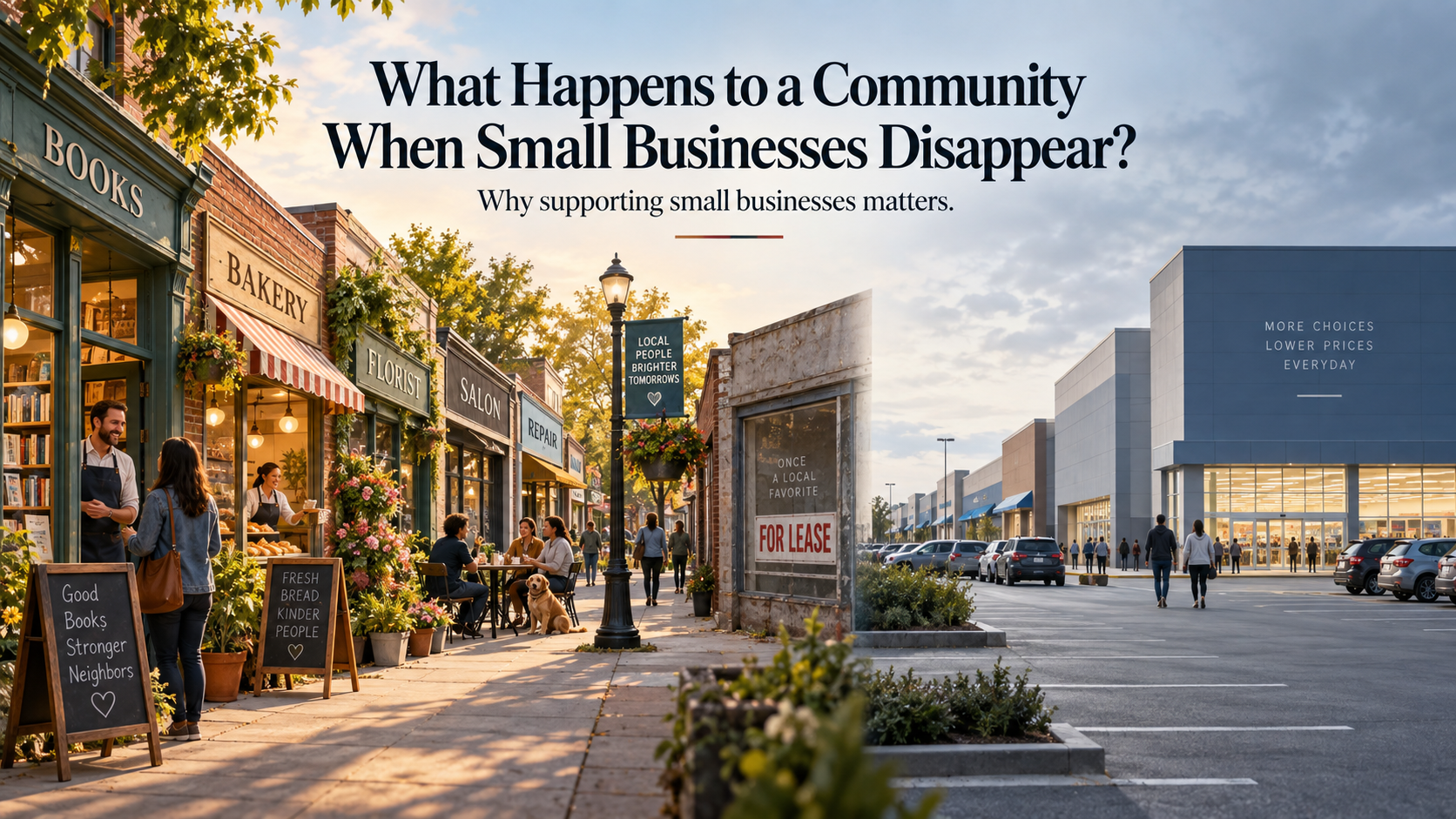
A new big-box store, national chain, or major online retailer can bring real benefits to consumers and communities. More selection. Convenience. Competitive prices. Jobs. Investment. Familiar products and services.
But there is another side of that economic change that is much easier to miss.
What happens when a large business does not simply join the existing business community, but begins replacing the small businesses that were already there?
The storefronts may still be occupied.
People may still be shopping.
Jobs may still exist.
From the outside, the community may still appear economically active.
But underneath, something fundamental can change:
The community can begin losing local ownership.
And when local ownership disappears, communities can lose much more than individual stores.
Small Businesses Usually Are Not Eliminated Overnight
A large corporation does not arrive in a community and immediately cause every competing small business to close.
The process can be much more gradual.
Research published in the American Economic Journal: Applied Economics examined how Walmart Supercenter openings affected existing supermarkets over an 11-year period.
When a Supercenter opened within one mile of an incumbent supermarket, researchers found an average 16% decline in the incumbent supermarket's revenue. The competitive effect declined considerably as the distance between the businesses increased.[1]
That distinction matters.
The greatest pressure is not simply created by the existence of a large business. It becomes particularly important when a large company and smaller businesses are competing for many of the same customers, in the same market, in the same geographic area.
And a 16% decline in revenue does not mean a small business immediately disappears.
Consider what happens first.
The rent does not decline 16%.
Insurance does not decline 16%.
Utilities do not automatically decline.
Equipment payments remain.
Licenses remain.
Debt remains.
Many payroll expenses remain.
A small business can therefore lose a meaningful portion of its sales while continuing to carry many of the same fixed costs.
The effects may begin quietly.
Employee hours are reduced.
A vacant position is not filled.
An expansion is postponed.
Marketing is cut.
The owner stops purchasing certain outside services.
Inventory is reduced.
Repairs are delayed.
The owner begins doing more personally because there is no longer enough revenue to pay someone else.
And eventually, if there is no longer enough margin for the business to survive, the doors close.
Large Businesses Compete With Advantages Small Businesses Cannot Easily Reproduce
A small independent retailer and a national corporation may technically sell the same product.
Economically, however, they may be operating in completely different worlds.
A large corporation can purchase enormous quantities of inventory and negotiate pricing that may be unavailable to a small purchaser.
It can spread the costs of advertising, technology, logistics, management, software, distribution, and customer programs across hundreds or thousands of locations.
It may have access to capital that allows it to withstand periods of lower profitability that an independent owner simply could not absorb.
And a large retailer may sell thousands of different products, allowing it to make less money in one category while generating profit somewhere else.
Then there is convenience.
Imagine a community where residents once purchased: groceries from a neighborhood market, medicine from a local pharmacy, garden supplies from a nursery, clothing from an independent retailer, household products from another store, and automotive supplies somewhere else.
A supercenter may allow a customer to purchase all of those things during one trip.
That convenience has real value to consumers.
But economically, it also means one large business can pull portions of spending away from several smaller businesses at the same time.
The result is not necessarily one corporation replacing one small business.
It can be one corporation gradually absorbing purchases that previously supported an entire collection of businesses.
The Research Shows the Difference Between Joining an Economy and Replacing Part of It
This does not mean every large business entering a community harms small businesses.
In fact, large businesses can create opportunities for them.
Research examining big-box expansion found significant negative effects on employment growth among nearby single-location businesses and smaller local chains when the big-box activity was both in the immediate area and in the same detailed industry.[2]
When those conditions were not present, the relationship was more complicated.
That makes sense.
A large manufacturing facility, hospital, distribution center, or major employer can bring hundreds or thousands of workers into an area.
Those workers need food. Childcare. Automotive services. Housing. Healthcare. Entertainment. Contractors. Professional services. Maintenance.
A large company can therefore create demand that surrounding small businesses are able to serve.
That is very different from a large retailer entering the same market and competing directly for the same purchases previously supporting smaller companies.
The more useful question is not:
Is big business good or bad for a community?
The better question is:
Is the large business adding economic activity to the local ecosystem, or is economic activity becoming increasingly concentrated within a few companies?
What Actually Disappears When a Small Business Closes?
This is where the conversation becomes much bigger than one storefront.
Suppose a locally owned business closes after years of declining revenue.
The visible loss is obvious.
The store is gone.
But consider everything connected to that business.
It may have hired a local accountant. A cleaning company. A photographer. A sign company. A landscaper. A repair business. A printer. A bookkeeper. A marketing professional. A caterer. A contractor. A web designer.
Those companies did not simply lose a neighboring business.
They lost a customer.
Small businesses are not only sellers within their communities.
They are buyers.
One business can generate revenue for several others simply by operating.
And those businesses purchase from still more businesses.
That is how a local business ecosystem develops.
The economic effect of losing one business therefore does not necessarily stop when its doors close.
Some of the relationships surrounding it disappear too.
A Community Can Keep the Commerce but Lose the Owners
This may be the most important distinction.
Imagine a community with 100 locally owned businesses.
That could represent 100 different owners.
One hundred people or families building equity in businesses. One hundred decision-makers deciding whom to hire. Where to purchase services. Which vendors to use. Whether to expand. Whether to open another location. Whether to hire another employee. Whether to sponsor something locally. Whether to give another entrepreneur an opportunity.
Now imagine that, over time, much of the consumer spending that supported those businesses becomes concentrated among a handful of national corporations.
The community may still have plenty of commercial activity.
There may still be stores. There may still be employees. Parking lots may still be filled with customers. Products are still being sold. Money is still changing hands.
But something has changed.
There are fewer local owners. There are fewer independent businesses buying from one another. There are fewer local people building business equity. There are fewer independent purchasing decisions.
Some decisions about products, vendors, marketing, expansion, and investment are now made elsewhere.
The community has not necessarily lost commerce.
It has lost some of its local economic ownership and decision-making power.
Those are not the same thing.
Small Businesses Give Back Differently
There is another contribution that economic statistics cannot fully capture.
Small businesses frequently become part of the social infrastructure of their communities.
They sponsor youth sports teams. Donate to school fundraisers. Provide raffle items. Help local nonprofits. Donate products or services. Participate in community events. Mentor young people. Give another small business a referral. Hire someone looking for a first opportunity. Put another entrepreneur's flyer on the counter. Contribute food to a community event. Help a longtime customer going through a difficult time.
Large corporations can give back too, sometimes on a scale no small business could possibly match. Corporate foundations, grants, sponsorships, charitable programs, and major donations can provide enormous community benefits.
Small businesses often give differently.
They give through proximity.
The person being asked for help may be speaking directly to the person who owns the business.
The owner may know the school. Know the coach. Know the family. Know the nonprofit. Know the other business owner. Know why the need matters.
A small-business owner may be able to decide today: Yes, we'll donate. Yes, we'll sponsor it. Yes, you can put your flyer here. Yes, I'll introduce you to someone. Yes, we'll help.
That type of participation is difficult to measure in revenue or employment statistics.
But it is part of what makes a business part of a community rather than simply a company operating within it.
The Next Small Business May Never Open
The consequences of increased market concentration do not necessarily stop with businesses that close.
They can also influence businesses that are never created.
Imagine someone thinking about opening an independent store.
Before investing savings, signing a lease, purchasing equipment, hiring employees, or taking on debt, that person has to determine whether the opportunity is viable.
Can they compete with the corporation's purchasing power? Its advertising budget? Its pricing? Its technology? Its convenience? Its enormous product selection? Its ability to withstand losses longer than a new small business could?
Sometimes the answer will be yes.
Small businesses can compete through specialization, expertise, innovation, relationships, exceptional service, culture, convenience of their own, or by serving needs a large company does not serve particularly well.
But sometimes the potential entrepreneur decides the market is no longer viable.
And that means a community can lose something that is almost impossible to see:
The business that was never opened.
Research examining the expansion of a major e-commerce company's fulfillment network demonstrates how this type of change can occur.
Researchers studying millions of stores found that sales and employment at geographically proximate traditional retailers declined following fulfillment-center expansion. Store exits increased, particularly among young and small stores, while the rate of new-store entry also declined.[3]
The economic effect was therefore not limited to existing companies.
It affected who remained and who entered afterward.
Over Time, the Structure of a Community Can Change
The U.S. Census Bureau has documented a broader transformation within American retail.
Researchers describe a retail sector that changed from one populated heavily by small firms to one increasingly dominated by large national firms between 1987 and 2017.[4]
That transformation did not happen because every independent business suddenly disappeared.
It happened over decades.
Expansion. Competition. Changing technology. Changing consumer behavior. E-commerce. Consolidation. Business entry. Business exit.
One closure at a time. One new chain location at a time. One purchasing decision at a time.
A similar transformation can occur within a community without immediately looking like economic decline.
One independent store closes. Another closes later. A national retailer fills one space. Another corporation fills another.
Consumers still have somewhere to shop.
Jobs remain.
The community may even gain conveniences it did not have previously.
But look underneath the commercial activity and the structure may be different.
Fewer independent owners. Fewer locally controlled businesses. Fewer business-to-business relationships among local companies. Fewer places for new entrepreneurs to enter. Fewer distinctive establishments.
And potentially greater dependence on decisions made by companies whose priorities extend far beyond that individual community.
Supporting Small Businesses Does Not Mean Rejecting Big Businesses
Healthy communities do not need to choose between large companies and small businesses.
Both can contribute.
Large businesses can provide scale. Major employment. Infrastructure. Investment. Supply-chain activity. Training. Technology. Convenience. Competitive pricing.
Small businesses provide something different.
Distributed ownership. Entrepreneurial opportunity. Specialization. Local relationships. Community participation. Business-to-business connections. Distinctive products and services. And more places for individuals and families to build something they own.
The goal should not be to eliminate one in favor of the other.
The danger comes when one becomes so dominant that the other can no longer remain part of the ecosystem.
A large business can be an anchor within a thriving local economy.
The concern begins when the anchor starts replacing the ecosystem around it.
This Is Why Supporting Small Businesses Matters
"Support small business" can sound like a slogan.
It means much more once we understand what is actually at stake.
Supporting a small business is not about buying something because we should feel sorry for the owner.
It does not mean never shopping at a large retailer.
It does not mean ignoring price, quality, convenience, or our own financial circumstances.
It means understanding that where a community spends its money helps shape what kinds of businesses are able to remain within that community.
Every individual purchase may seem insignificant.
Collectively, those purchases create markets.
They determine which businesses have enough revenue to renew a lease. Which restaurants can continue serving customers. Which owners can hire someone. Which companies can continue buying from other small businesses. Which entrepreneurs believe opening something new is worth the risk.
And which businesses eventually disappear because there is no longer enough demand to sustain them.
Once a locally owned business closes, filling the building does not necessarily replace everything the community lost.
Another store may sell the product. Another company may employ workers. Another website may ship the item.
But that does not automatically replace: the local owner building equity in that business, the small companies it purchased from, the relationships it developed, the community organizations it quietly supported, the decisions that were once made locally, the business it might have grown into, or the future entrepreneur who saw that business and realized building something of their own was possible.
That is the deeper reason supporting small business matters.
Because a community can still have places to shop while gradually losing the people who own a meaningful piece of the economy around them.
And once local ownership disappears, rebuilding it may be much harder than preserving it in the first place.
Sources & Research
-
[1] The Competitive Effects of Entry: Evidence from Supercenter Expansion
Peter Arcidiacono, Paul B. Ellickson, Carl F. Mela & John D. Singleton. American Economic Journal: Applied Economics, Vol. 12, No. 3, 2020.
Researchers found that Walmart Supercenter entry within one mile of an incumbent supermarket produced a sharp 16% decline in incumbent revenue, with the effect decreasing substantially with distance.
-
[2] Mom-and-Pop Meet Big-Box: Complements or Substitutes?
John C. Haltiwanger, Ron S. Jarmin & C. J. Krizan. National Bureau of Economic Research Working Paper No. 15348; subsequently published in the Journal of Urban Economics.
The study found substantial negative effects of big-box entry and growth on employment growth at nearby single-location and smaller-chain retailers when the businesses were in the immediate area and the same detailed industry. It also found more varied effects when the businesses were not direct competitors.
-
[3] Creative Destruction? Impact of E-Commerce on the Retail Sector
Sudheer Chava, Alexander Oettl, Manpreet Singh & Linghang Zeng. National Bureau of Economic Research Working Paper No. 30077, 2022.
Using data covering millions of retail workers and stores, researchers found declines in sales and employment among geographically proximate traditional retailers following fulfillment-center expansion. Store exits increased—particularly among younger and smaller stores—and new-store entry declined.
-
[4] Productivity Dispersion and Structural Change in Retail Trade
Dominic Smith, G. Jacob Blackwood, Michael D. Giandrea, Cheryl Grim, Jay Stewart & Zoltan Wolf. U.S. Census Bureau Center for Economic Studies Working Paper CES-23-60R, 2023.
The researchers document the long-term transformation of U.S. retail from a sector populated heavily by small firms to one increasingly dominated by large national firms between 1987 and 2017, while also documenting productivity and wage advantages associated with larger national retailers.
Research is included to provide context on documented changes in retail competition, business entry and exit, employment, and industry structure. Effects differ by market, industry, geography, business model, and competitive conditions.