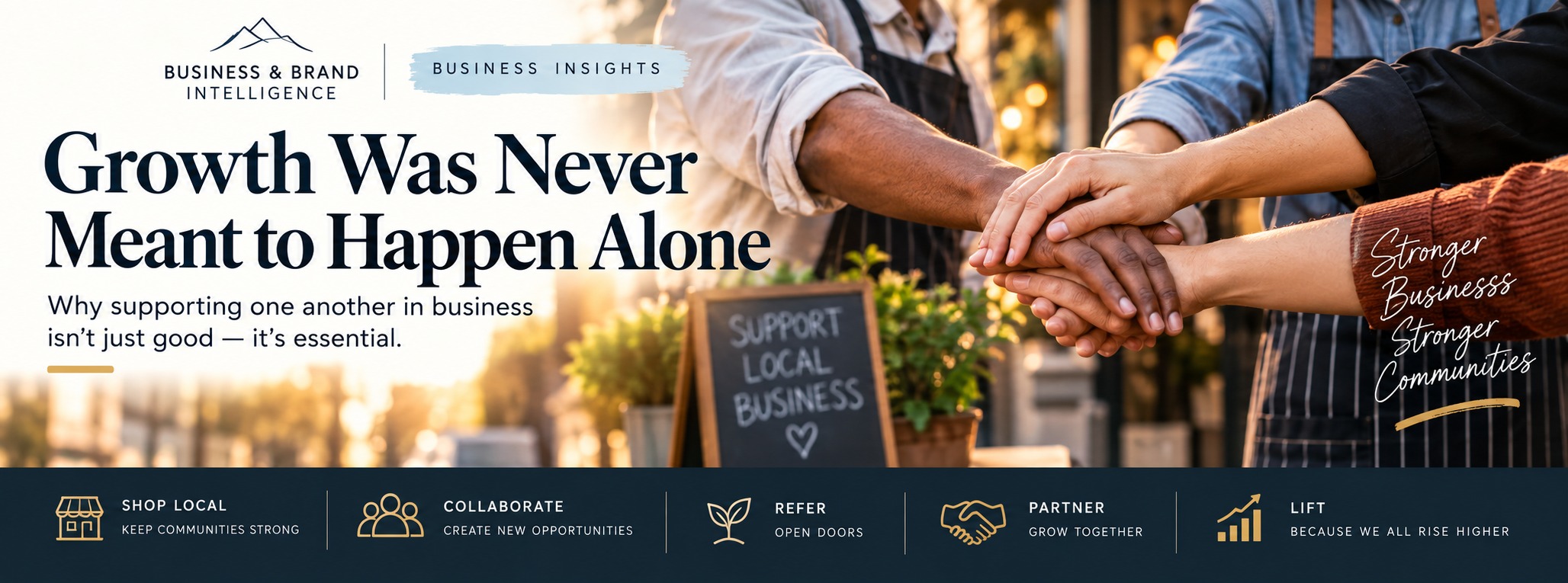
There is something I have been thinking about deeply as I build Business & Brand Intelligence.
Not simply how businesses grow.
But how we choose to help one another grow.
Because somewhere along the way, business became associated with competition in a way that sometimes makes us forget that we are still human beings first.
Business is not a game show. It is not a race where there is only one finish line and one winner standing at the end. At least, it does not have to be.
We teach our children to be good sports.
We tell them to help someone who falls.
We teach them not to laugh at the child who is struggling.
We encourage them to include people, share, cooperate, celebrate their friends, and sometimes even root for the underdog.
We try to teach them that winning does not require someone else to feel small.
And then many of us grow up and enter a world that tells us almost the opposite.
Protect your opportunity.
Protect your customers.
Protect your information.
Protect your connections.
Make sure you get there first.
Someone else’s success might mean there is less available for you.
But what if that is one of the ideas we need to reconsider?
Because the truth is, opportunity is not only something we find. Opportunity is something human beings create for one another every single day.
Someone hires you.
Someone recommends you.
Someone tells a friend about your business.
Someone introduces you to the right person.
Someone decides to give the small company a chance instead of automatically purchasing from the largest name they recognize.
Someone chooses your restaurant.
Someone books the independent hairstylist.
Someone buys the candle from the woman making them at her kitchen table.
Someone hires the local photographer.
Someone orders from the neighborhood bakery.
Someone leaves the review.
Someone shares the post.
Someone answers the email.
Someone says your name in a room you are not standing in.
That is how opportunity moves.
Through people.
And every one of us participates in that system.
Small Business Is the Underdog
When we talk about supporting the underdog, perhaps we should recognize who the underdog increasingly is in today’s economy.
It is the small-business owner.
The person trying to compete against companies with entire marketing departments, legal teams, analysts, purchasing departments, technology divisions, artificial intelligence systems, enormous advertising budgets, established distribution networks, and access to capital that most small-business owners could never imagine.
Meanwhile, the small-business owner may be doing everything alone.
They are answering the phone.
Creating the product.
Posting on social media.
Managing inventory.
Sending invoices.
Solving customer problems.
Learning new technology.
Paying bills.
Trying to understand marketing.
Trying to understand taxes.
Trying to figure out why something in the business is not working.
And sometimes doing all of that after putting their children to bed or before going to another job.
That is the person standing across the economic playing field from some of the largest organizations in the world.
And yet we often talk about small businesses as though they simply need to “compete harder.”
But maybe the question should also be:
What responsibility do the rest of us have to make sure they have a fighting chance?
Not through pity.
Not through charity.
Through participation.
Supporting Small Business Is Something We Actually Do
“Support small business” has become a phrase we see everywhere.
But support is not a slogan.
It is an action.
Sometimes supporting another small business means referring a customer.
Sometimes it means sharing knowledge.
Sometimes it means creating a partnership.
Sometimes it means making an introduction.
And sometimes it is much simpler than that.
Sometimes it means buying something.
If you own a small business and need printed materials, can another small business print them?
If you need catering, is there a local restaurant you can hire?
If you need photography, accounting, bookkeeping, cleaning, web design, flowers, gifts, transportation, consulting, or another service, is there another small business you can support?
Businesses are consumers too.
Every business makes purchasing decisions.
And those decisions create economies.
Imagine what would happen if small-business owners intentionally looked for opportunities to purchase from one another.
Not when it makes no financial sense.
Not because anyone should accept poor service.
Not because small businesses should be exempt from earning someone’s business.
But when quality, value, and fit are there, perhaps we can make a conscious decision to allow more of our dollars to circulate through the communities we say we care about.
Because every purchase is more than a transaction.
Behind many small businesses is someone’s rent.
Someone’s mortgage.
Someone’s child’s dance lessons.
Someone’s groceries.
Someone trying to pay an employee.
Someone trying to become financially independent.
Someone trying to turn an idea they believed in into something real.
There is a person behind the business.
And sometimes I think we forget that.
Your Success Does Not Require My Failure
There is another belief worth challenging.
The idea that someone else growing somehow threatens our own growth.
Of course businesses compete.
Two companies may want the same customer.
Two restaurants may operate on the same street.
Two consultants may provide similar services.
Competition will always exist.
But competition does not require hostility.
It does not require withholding every opportunity.
And it certainly does not require believing there can only be one successful person in the room.
There are millions of customers.
Millions of businesses.
Millions of needs.
Different people connect with different brands, different personalities, different approaches, different products, and different experiences.
The existence of someone else’s business does not erase the reason yours exists.
Another person succeeding does not automatically mean you have lost.
We have been conditioned to look horizontally at one another and ask:
Are they getting ahead of me?
Maybe we should spend more time asking:
How much farther could all of us go if we stopped trying to climb over one another?
We Were Made for Community
Human beings have survived because of community.
Long before corporations, algorithms, advertising platforms, business schools, and economic systems existed, people relied on one another.
We hunted together.
Built together.
Raised children together.
Protected one another.
Shared knowledge.
Traded resources.
Passed skills from one generation to another.
Community was not some nice additional feature of human existence.
It was how we survived.
And underneath all of the technology and structures we have created, that has not changed as much as we sometimes pretend it has.
We still need people.
Every business depends on people.
Customers.
Employees.
Partners.
Mentors.
Vendors.
Suppliers.
Friends.
Family.
Communities.
Someone believed in every successful business before the rest of the world knew its name.
Someone purchased first.
Someone referred first.
Someone encouraged first.
Someone opened a door.
We do not build alone.
And maybe that is something worth remembering before we decide that someone else’s struggle has nothing to do with us.
Community is not charity from the strong to the weak. Our positions change.
At different points in life, every one of us can be the person giving support or the person needing it.
Today, you may be the one opening the door for someone else.
Tomorrow, you may be the one hoping someone keeps a door open for you.
Success does not permanently place us on one side of that exchange, and struggle does not permanently place us on the other.
Life changes.
Business changes.
Markets change.
Industries change.
Technology changes.
Circumstances change.
Today your customers may be coming in. Your bills may be paid. Your business may feel secure. You may believe you have everything handled.
Tomorrow, you may be the person who needs the referral.
The introduction.
The customer.
The recommendation.
The opportunity.
The person willing to say, “I know someone who can help you.”
Today you may not need help. Tomorrow you may. And when you look around, do you want to be standing alone?
That is what community asks us to remember.
Supporting someone else today is not a guarantee that the same person will someday return the favor.
Community is bigger than a transaction.
It is about helping create a culture where people do not have to face every difficult season by themselves.
A culture where we understand that fortunes change.
Where success and struggle can exist in different seasons of the same life.
Where we recognize that none of us is permanently the person with the advantage, and none of us is permanently the underdog.
Sometimes we are the person reaching for a hand.
Sometimes we are the person in a position to extend one.
The kind of world we create depends, in part, on what we choose to do when it is our turn to extend our hand.
That is why supporting one another matters.
Not because we owe one another charity.
But because we understand that we are human, circumstances change, and none of us moves through life entirely on our own.
The World Is Changing — and We Get to Decide What Changes With It
We are entering a world shaped by technology that is advancing faster than most of us can fully process.
Artificial intelligence will change businesses.
Automation will change jobs.
Large companies will continue gaining capabilities that were unimaginable even a few years ago.
There is plenty about that future we cannot control.
But there is something we can control.
Who we become inside of it.
Technology can become more advanced without humanity becoming less human.
Efficiency does not have to replace empathy.
Growth does not have to replace community.
Innovation does not have to eliminate generosity.
And business does not have to become a place where everyone believes there is only enough room for a handful of winners.
We get to participate in deciding what comes next.
Every time we make a purchase.
Every time we give a referral.
Every time we make an introduction.
Every time we collaborate.
Every time we choose to help someone instead of seeing them only as competition.
Every time we recognize another person’s dream as something worthy of having a chance.
Those choices may feel small individually.
Collectively, they shape culture.
This Is About More Than Business
Ultimately, this is not simply a conversation about entrepreneurship.
It is a conversation about consciousness.
About what we value.
About whether progress means becoming more isolated or more connected.
About whether success means accumulating as much as possible for ourselves or creating enough space for other people to rise with us.
There is nothing wrong with wanting your business to succeed.
There is nothing wrong with wanting financial security, growth, recognition, or wealth.
But perhaps success becomes something even more meaningful when we can look around and know that our growth created opportunity beyond ourselves.
That because our business existed, someone else got hired.
Someone else received a referral.
Someone else made a sale.
Someone else discovered a customer.
Someone else was encouraged not to quit.
Someone else got their chance.
Opportunities are what we give ourselves.
But they are also what we give one another.
And perhaps one of the most powerful things we can remember as humanity moves into whatever comes next is this:
There does not have to be only one winner.
There never did.
We are allowed to build our businesses.
We are allowed to pursue our own dreams.
We are allowed to want more.
And we are still allowed to reach back, reach across, and help somebody else move forward too.
Because we were never meant to build everything alone.
We were made for community.
And the future of business will ultimately become whatever we collectively decide to make it.
Small Business Still Matters.
And maybe supporting one another is one of the ways we make sure it continues to.